Categories
Bank

The renewed relevance of cooperative and mutualist banks

This change, which reflects a profound shift in our societies, and which confirms the need to move away from shareholder capitalism toward partnership capitalism, points to the renewed relevance of cooperative and mutualist banks. They view their customers as a fundamental stakeholder since, as partners, they hold their capital, constitute and represent their governance (in the general meetings, on the boards of directors, and on the supervisory boards which control the executive). The governance of cooperative and mutualist banks is, therefore, organised in such a way that they are naturally “customer centric”.

In addition, the banks instinctively think in terms of regions and territories. This is because their board members are drawn from among customers living in the areas where they are located and where they conduct their business.

Employees, for their part, are more involved in the strategy pursued, given the size of the banking ISEs in question. In some companies, their representatives already took part in board meetings, even before it became a requirement.

Cooperatives and mutualist banks are often, by their nature, economically and socially committed to their territories because they live in osmosis with them. If things are going well, they contribute to the health of their regions. If the regions are doing well, the regional bank’s growth is facilitated. Their economic involvement is, therefore, a prerequisite for their existence. In this respect, it is absolutely indispensable for banks to continue to finance their region, even when it is experiencing an economic downturn. There is no savings fungibility for regional banks which would justify moving and reallocating savings to the detriment of a region based on the sole argument that the profit/risk ratio would be better there than here. The savings held by cooperative and mutualist banks are, therefore, used to fund the life and company projects of local customers and to support the local economy, regardless of the current environment.

This commitment is also seen in their CSR approach. They make a point of using a portion of their profits to finance general interest missions. These include cultural and sports initiatives, both of which promote social cohesion, and the transmission of knowledge and equal opportunity, which also contribute to cohesion by their very nature. The same holds true for the energy transition.

Cooperative banks are fully involved in the economic dynamic and social cohesion of the regions. This dynamic requires a strong local presence which contributes to making the banks unique. Relational, decision-making and managerial proximity is very important. The relationship between customer and bank must be sustainable and it conditions the ability of banks to do their job well and be profitable. In addition, the credit decisions of cooperative and mutualist banks are taken locally, in the region. Lastly, given the size of these banks and the regional presence of their management, who are true banking ISE entrepreneurs, managerial proximity is very strong. This is essential because retail banking is a services product and the ability to mobilise teams for the benefit of customers can be highly differentiating. This also ensures that they are responsive and can quickly adjust their strategy and their organisation to better meet the changing needs of customers and support their profitability.

The fact that regional cooperative and mutualist banks are not listed and are not dependent on the stock markets means that their vision is not limited by the short-term approach which sometimes defines the exchanges or by the often mimetic imperatives seen on the financial markets.

Categories
Bank

The crucial role of commercial banks

Commercial banks are companies that, like others, produce an offer that must meet a demand, by mobilising human resources and capital. Their effectiveness can be seen through their ability to achieve sufficient results to ensure their continuity and growth. But banks have the particularity of being subject to very heavy regulation, which well exceeds that relating to any other sector. They manage – and so must protect – savings and, individually, they are a link in systemic risk. This risk must be averted so as to safeguard the financial system, the very lifeblood of the economy.

Banks are central to financing the economy. We can clearly see in emerging countries that the quest for growth goes through the development of banks and the adoption of banking among the population, because savings placed in “piggy banks” cannot be mobilised to finance economic growth.

In developed countries, even though recent decades have seen a sharp increase in the relative contribution of financial markets to the overall financing of the economy, banks have a crucial role, for several reasons it is worth reiterating. First of all, they play a strong brokerage role in the economy, which consists of aligning, through their balance sheets, the financing needs of certain parties and the financing capacities of others. Financial markets have the ability to mobilise savings to finance the economy, but they do so on a small proportion of economic agents, both on the savers’ side and that of the economic agents to be financed. There is very strong asymmetry of information between the issuer and the purchaser of securities. Gaining access to the financial markets is therefore difficult. The vast majority of financial markets are reserved for companies that are large enough to meet the requirements of visibility, financial communication and recurrence of emissions, without any reference to individuals and professionals, who of course cannot finance themselves on the markets. At the same time, savers do not all have sufficient time, information or the skills necessary to understand the risks inherent in the financial markets, even though they would go through investment funds, for example.

Unlike financial markets, which are opportunity markets, commercial banks have a long-term relationship with their individual, professional and corporate clients, which they finance and whose investments and flows they also manage. This comprehensive, long-term relationship gives them capacity for fine analysis that reduces information asymmetry “industrially”. We should add that by carrying loans and deposits on their balance sheets, banks do not directly bring together the borrower and the saver. They thus greatly facilitate a much higher number of financing operations than if they had to wait for the wishes of borrowers and lenders to coincide with each other. And they do this in terms of the desired levels of credit risk, loan and investment duration and other types of interest rate.

Banks thus in particular take on a credit risk, with depositors taking this risk only on the bank itself. This remarkable function undertaken by banks is key to financing the economy, while the market leaves this risk to investors. If commercial banks play a vital role, it is also because they bear the maturity transformation risk on their own income statements. Savers want short-term and liquid investments, while borrowers are most often willing to borrow over the medium to long term, whether households for their properties or companies for their investments. For their part, financial markets meet this maturity transformation need through secondary markets, but the risks considered are then left to the economic agents themselves. By investing in the medium to long term amounts that may be necessary in the short term, savers are faced with a liquidity risk, and the crisis of 2007-2009 was a forceful reminder of its existence. They must also take on an interest rate risk, i.e. a risk of capital gains or losses on the investments made, in the event that rates fall or rise. Investment funds mutualise the risk for the benefit of savers, but do not in the least remove it from them. Conversely, banks cover the liquidity risk, as well as interest rate risk.

All in all, therefore, commercial banks are risk hubs that carry credit, liquidity and interest rate risks on their own income statements. The role of the bank is to take the risks that economic agents are either unaware of or do not want to take. It also ensures professional, regulated and supervised management, having the equity calculated to be able to absorb them. In this way, they play a unique, crucial and indispensable role in the economy.

Finally, through credit that generates deposits of the same amount, banks create money, under the regulation provided by central banks. They can therefore, as an aggregate, lend money even before it has been saved. In this way, they can set up additional means of payment, in anticipation of the creation of future wealth. For their part, the financial markets do not create money; they make pre-existing capital circulate.

In addition, the financial markets are very useful because, on the one hand, they make it possible to finance, particularly through equity markets, that which cannot reasonably be financed by bank credit, and, on the other, they complement financing from banks, with significant amounts. They cannot provide all the necessary financing due to their limited amount of capital by design and compliance with the essential regulatory solvency ratios. Finally, the markets facilitate the circulation of financial risk, thanks in particular to derivatives.

It is therefore necessary to find the pertinent relative reciprocal contributions to financing the economy between the financial markets and commercial banks, both indispensable. The development of financial markets in the 1980s increased funding opportunities and necessarily made banks more efficient and more competitive. However, given their specific characteristics – in particular their self-referential behaviour, faced with the difficulty of knowing the fundamental value of the prices of financial assets, with the future being difficult to probabilise – the financial markets behave in a more volatile and imitative manner than banks. The right proportion between markets and banks – well regulated – is thus in itself crucial to financial stability, a good economy and the well-being of everyone.

Categories
Bank

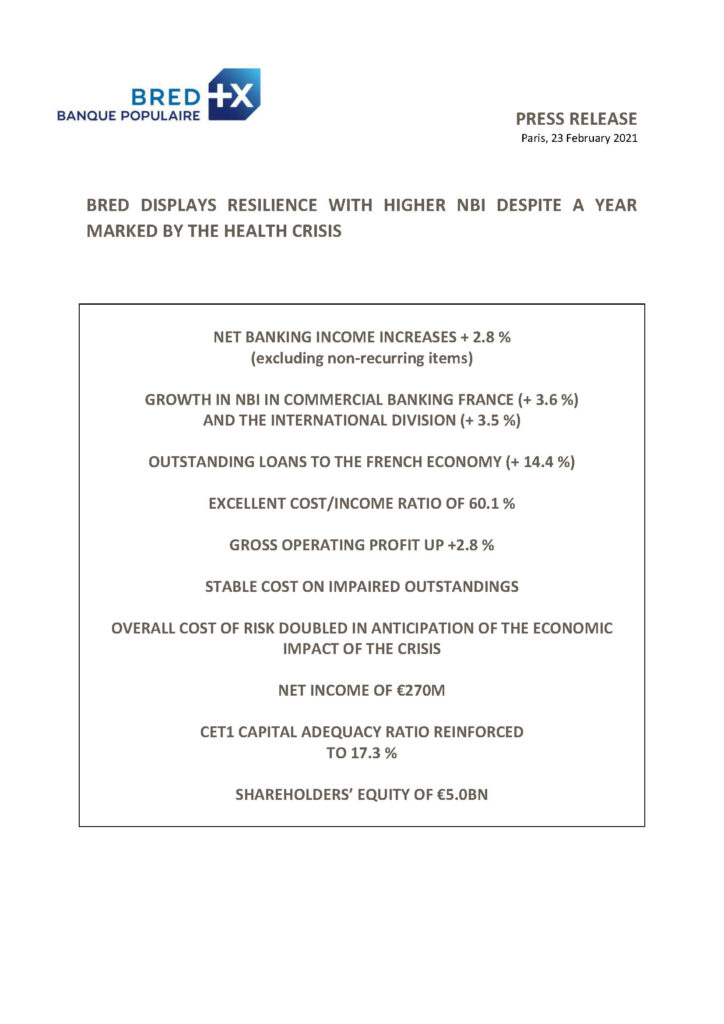
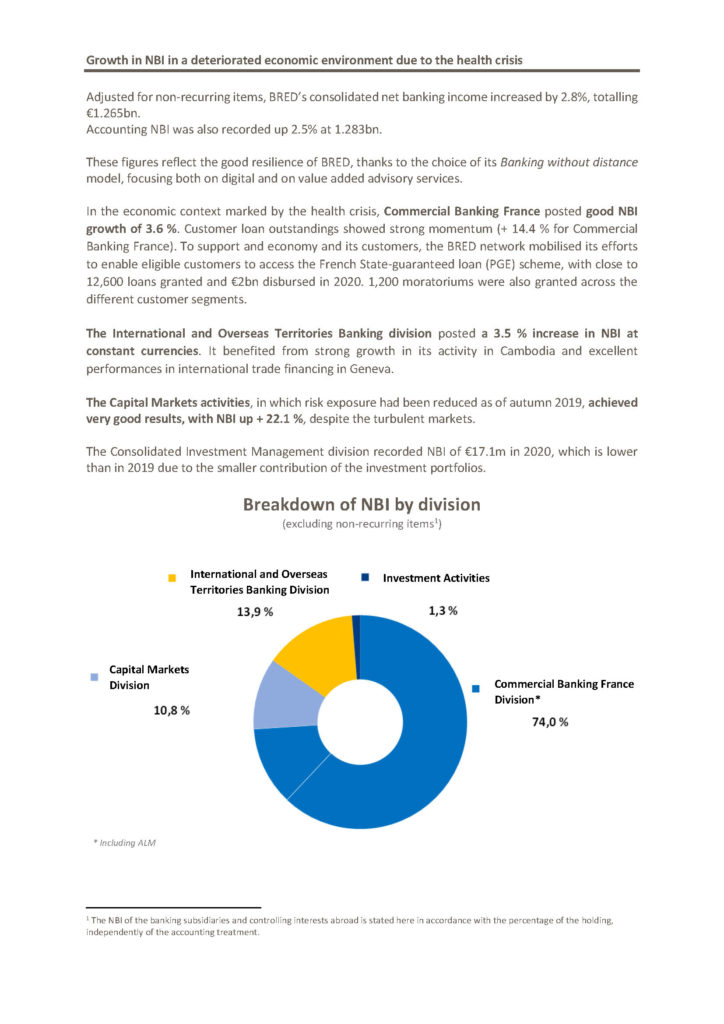
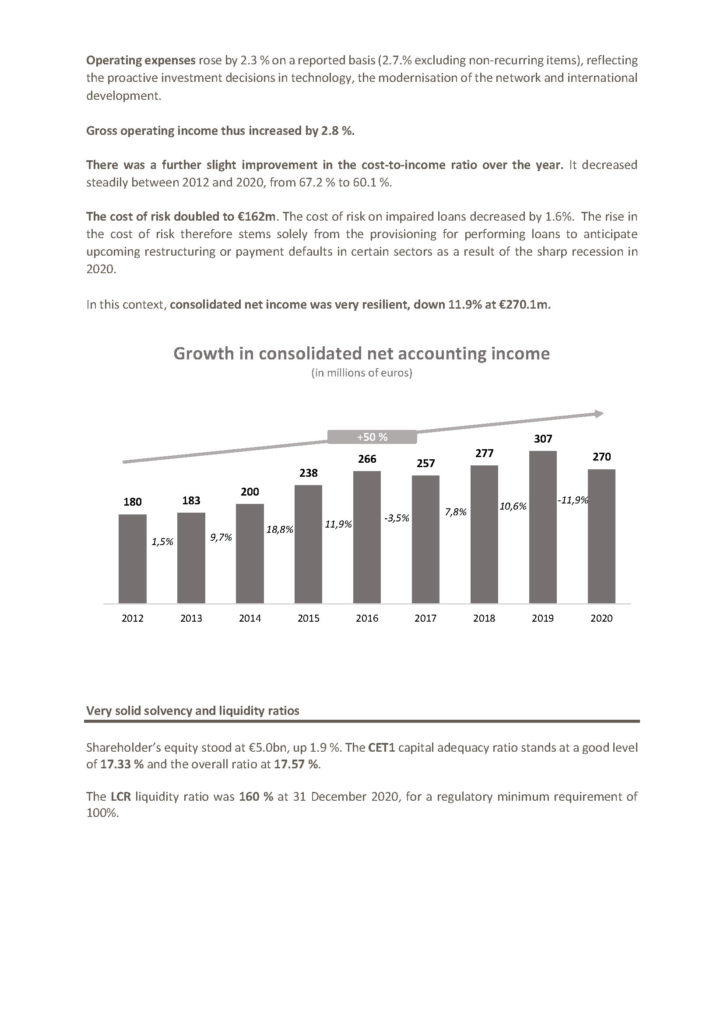
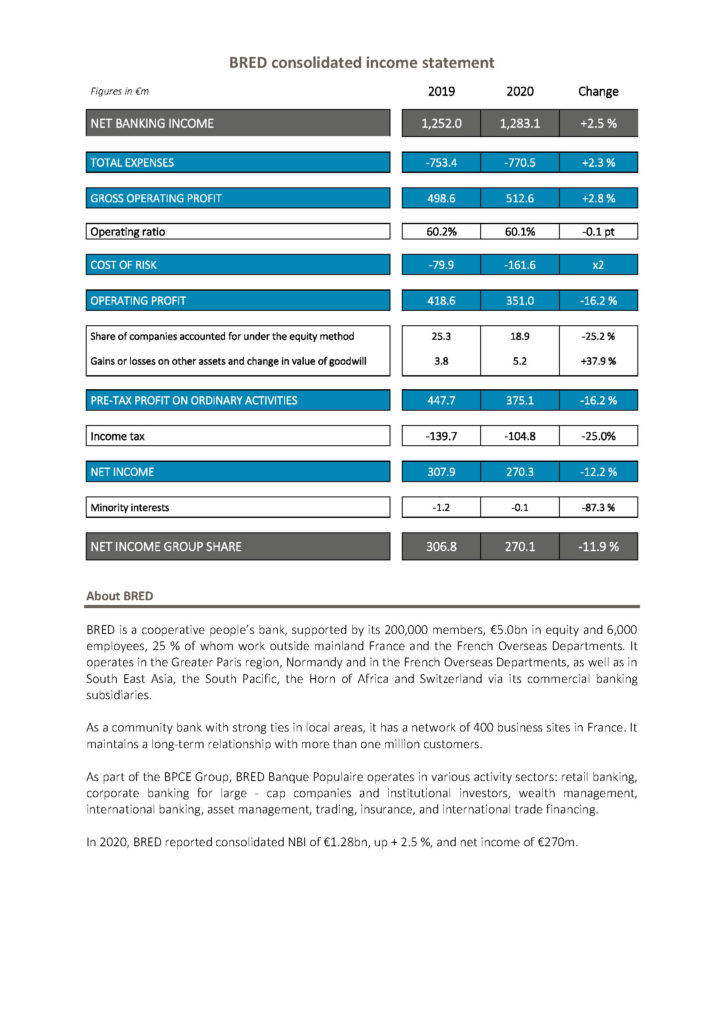
BRED 2020 annual results

Categories
Bank Euro zone

Pan-European banking consolidation: need and dangers


The European Central Bank (ECB) is calling for banking concentration in Europe. For monetary policy to be effective, it is desirable to have greater integration in financial markets and the banking system in Europe. This would in fact contribute to better regulation of the eurozone.

To set this process in motion, the ECB is currently working to ease the prudential framework in relation to banking sector consolidation. It has consulted stakeholders on these new guidelines, particularly on capital and liquidity requirements, which do not currently encourage cross-border movements within the sector. 

While the market welcomes this progress, other issues may hinder the creation of a real merger trend and the emergence of large Pan-European banks.

First of all, cross-border tie-ups do not always generate significant economies of scale, since banking and financial products within the European Union continue to be subject to very different regulation and taxation. Economies of scale in infrastructure therefore almost never work: IT systems mostly remain domestic. This issue can also be observed in other sectors. 

Second, as can be seen from the history of a number of large groups in numerous sectors of activity, mergers do not necessarily lead to greater efficiency. More than one merger in two does not create value, and may even destroy it. The race for size is not therefore always intrinsically favourable. 

Finally, and also in terms of financial stability, what has become of “too big to fail”, which regulators highlighted, not without reason, after the crisis of 2008-2009 as a guarantee of security? Is it not counter-intuitive to seek to create even more powerful banking groups when it would be even more difficult not to support them in the event of a major banking and financial crisis?

These questions need to be properly examined and shared if the desired search for large European banking players is to continue in an appropriate manner. 

Categories
Bank Economical policy Euro zone

Facing the triple crisis (pandemic , economic and financial), the European project needs audacious solidarity and coordination!

Find here the European League for Economic Cooperation call for action signed by all sections’ Presidents: European League for Economic Cooperation – Call to Action

Olivier Klein

Bernard Snoy et d’Oppuers (President ELEC International), Rainer Boden (ELEC International), Servaas Deroose (Special Advisor to President ELEC International), François Baudu (ELEC International), Javier Arias (ELEC International), Olivier Klein (ELEC France), Andreas Grünbichler (ELEC Austria), Branco Botev (ELEC Bulgaria), Frances Homs Ferret (ELEC Spain), Thomas Cottier (ELEC Switzerland), Maciej Dobrzyniecki (ELEC Poland), Antonio Martins da Cruz (ELEC Portugal), Radu Deac (ELEC Romania), Philippe Jurgensen (President ELEC Economic and Social Commission), Wim Boonstra (ELEC Netherlands and Monetary Commission), Senen Florensa (Mediterranean Commission).

Categories
Bank

Annual Results 2019 – BRED posts strong growth in net income in 2019, up 11 % to €307M, for a 5 % increase in NBI, to €1.252BN

20200227 - BRED - EN - 2019_Page_1

Find the full press release here : 20200227 – BRED – EN – 2019