Categories
Bank

Annual results 2021

SUSTAINED AND REGULAR GROWTH IN NBI SINCE 2012
HISTORIC RESULTS IN 2021

In 2021 :

INCREASE IN NET BANKING INCOME OF +13.5%
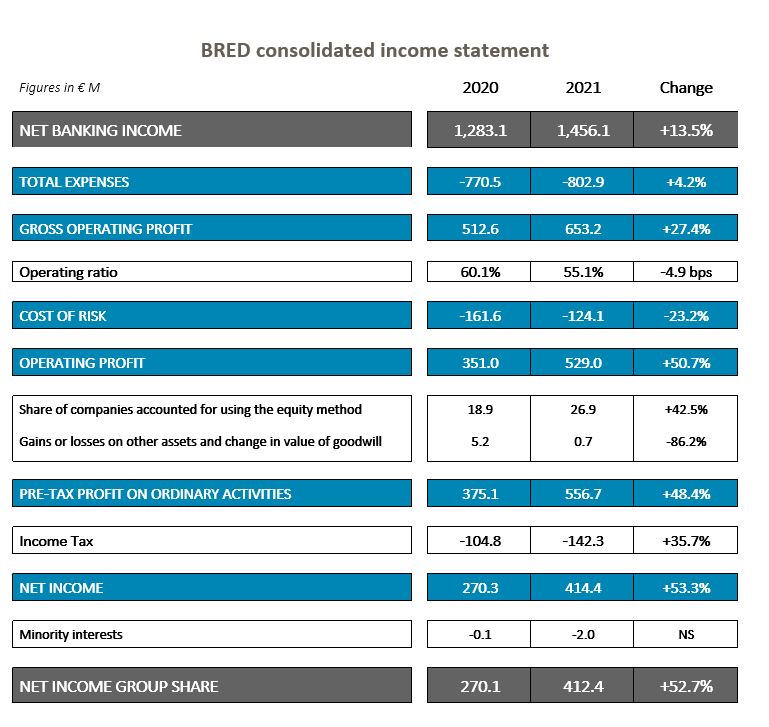
NET BANKING INCOME €1,456.1 M

GROWTH IN NBI IN COMMERCIAL BANKING FRANCE (+5.4%)
AND THE INTERNATIONAL DIVISION (+25.7% at constant exchange rate)

CAPITAL MARKETS DIVISION RESULTS MAINTAINED AT A HIGH LEVEL

EXCELLENT COST/INCOME RATIO AT 55.1%

NET INCOME OF €412.4 M, UP 52.7%

NEW SUCCESSFUL CAPITAL INCREASE (€120 M) TO SUPPORT BRED’S DEVELOPMENT

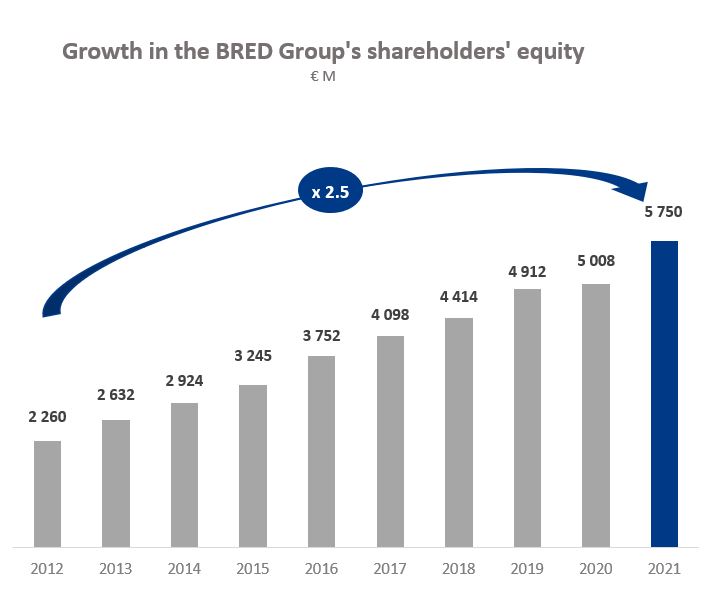
STRONG GROWTH IN SHAREHOLDERS’ EQUITY TO €5.8 bn (+14.8%)

VERY GOOD CET1 CAPITAL ADEQUACY RATIO AT 16.5%

“Our very good results for 2021 across all of our activities are part of a long chronicle of growth. They are driven by the intensification of the global value-added relationship of proximity in each of our customer segments, from individuals to companies of all sizes, in France and internationally. Our banking without distance strategy, with the deployment of 100% advisory branches since 2019, is once again showing its full relevance. Its cost/income ratio and the trend in shareholders’ equity underscore the solidity of the BRED Group,” explains Olivier Klein, Chief Executive Officer of the BRED Group.

Earnings on the increase, with sustained NBI growth over the past 9 years

The BRED Group recorded a sharp increase in net banking income (NBI) (13.5%) to €1,456.1 M.

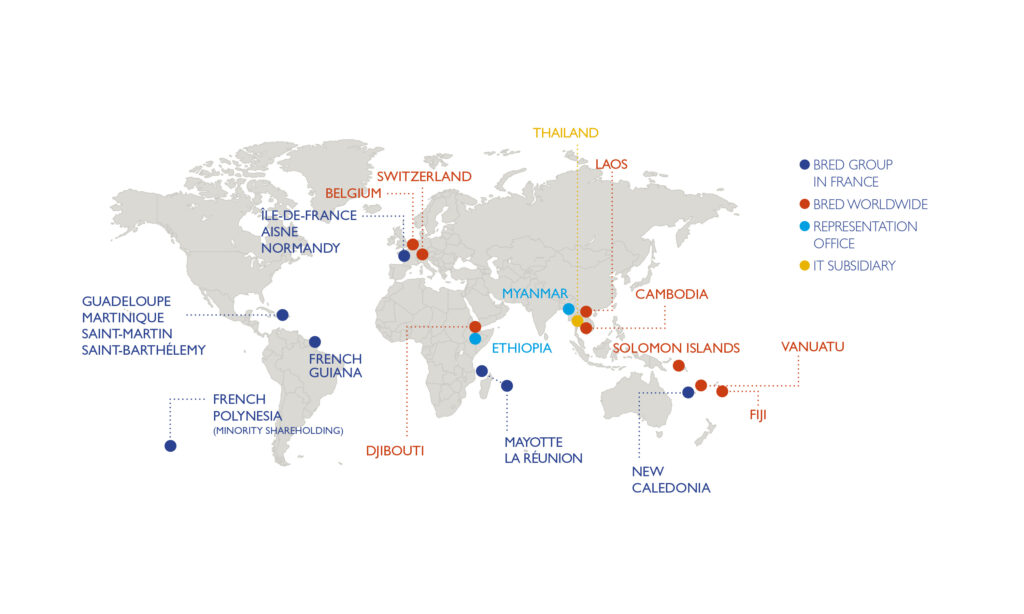
These figures bear witness to the success of the banking without distance strategy implemented by BRED over the past few years, both in France (mainland, overseas departments and New Caledonia) and in the emerging countries in which it operates: Djibouti, Cambodia, Laos, Solomon Islands, Vanuatu and Fiji, focusing on both digital and high value-added consulting.
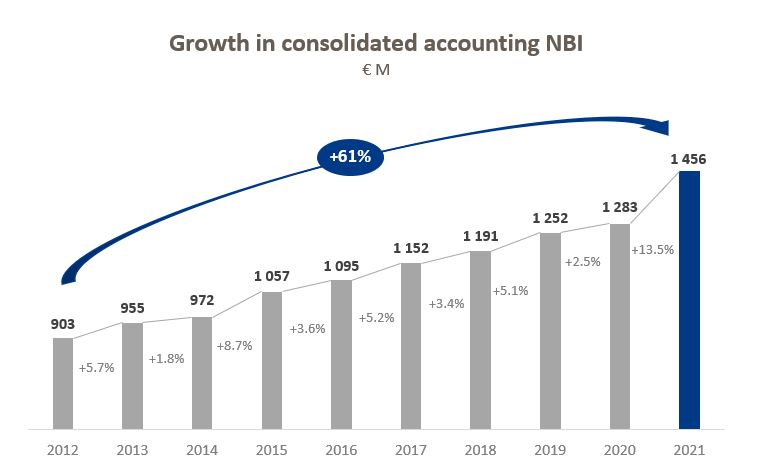
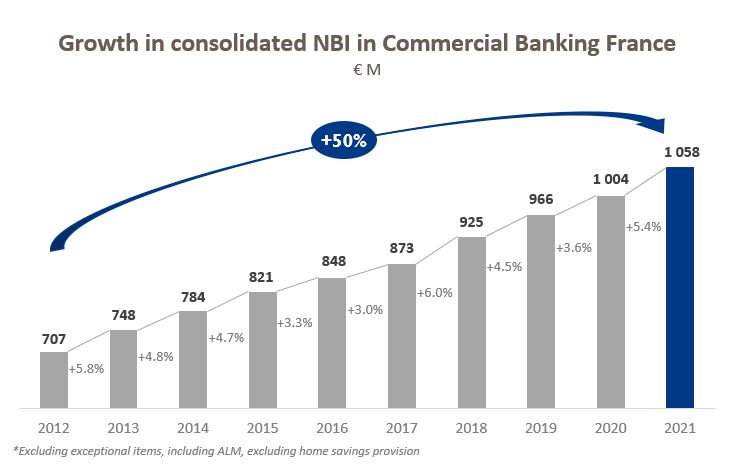
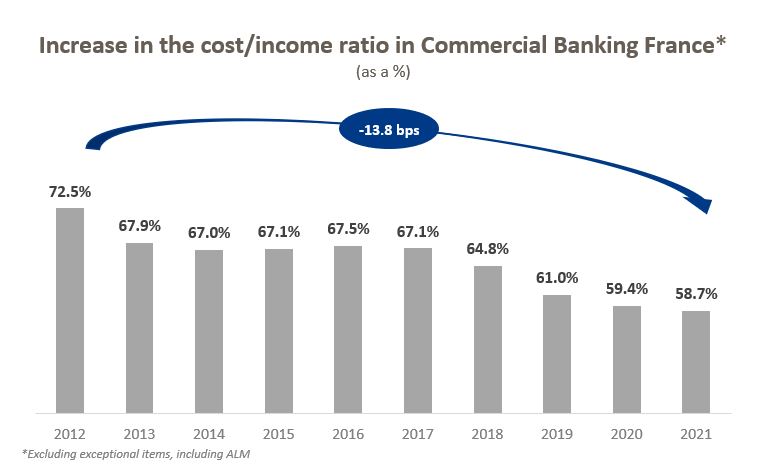
The remarkable growth in NBI is driven by all business lines and in particular commercial banking in France (including ALM), which recorded an increase in NBI of 5.4% and continuous cumulative growth from 2012 to 2021 of 50%. This is due to the banking without distance model which fosters a global value-added proximity relationship with each customer segment. The increase in outstanding customer loans (+14%) remained very dynamic over the whole of 2021. The BRED network also continued to mobilise its efforts to support the economy and its customers, with nearly 15,000 state guaranteed loans (PGE) for an amount of €2.3 bn disbursed since the system was put in place.

The International and Overseas Territories banking division posted a 25.7% increase in NBI at constant exchange rates. It benefited from an excellent performance in the financing of international trade in Geneva and from the strong growth of its commercial banking activity, particularly in the Fiji Islands and Cambodia.

The Capital Markets activity maintained a very good level of results and contributed 9% to the BRED Group’s NBI.

The consolidated investment management business grew strongly due in particular to the excellent performance of the private equity portfolio.
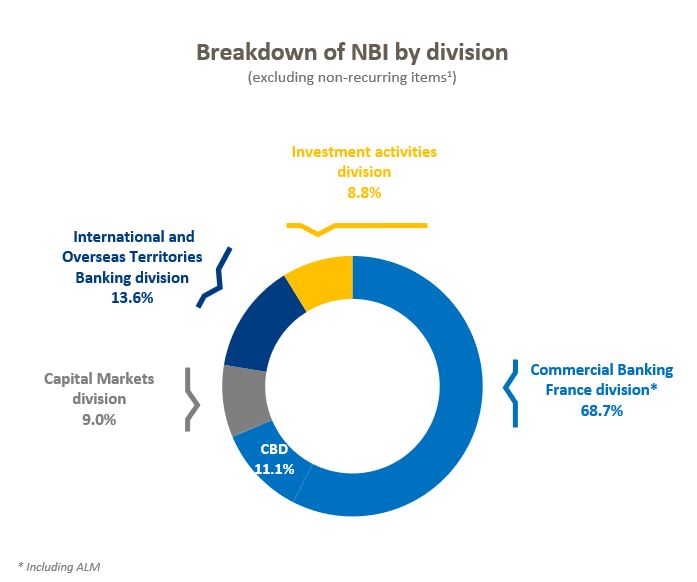
[1]The NBI of the banking subsidiaries and controlling interests abroad is stated here according to the percentage of the holding, irrespective of the accounting treatment.

Operating expenses increased by 1.7% restated for non-recurring items and the increase in variable remuneration resulting from the improvement in results. This reflects the continuous effort of investment in information systems and the digitization of processes, investment in the modernization of the branch network and in training, as well as in international expansion. Total operating expenses increased by 5.5%.

Gross operating income, up 27.4% (28.1% excluding non-recurring items), benefited from the sharp increase in NBI.

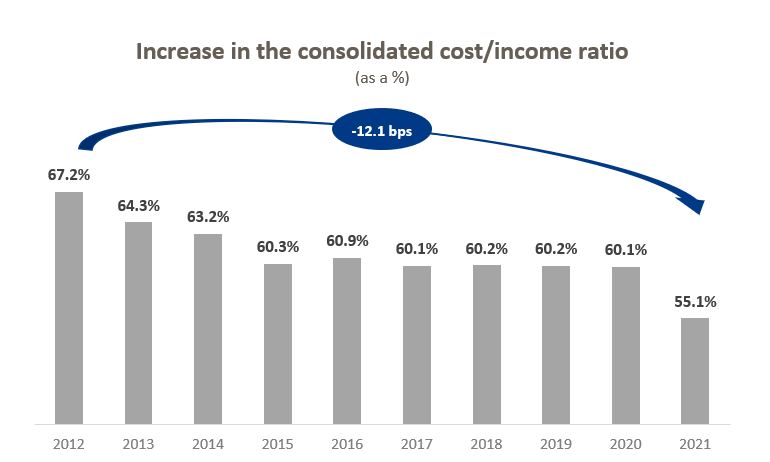
Down by more than 12 points since 2012, the cost/income ratio stood at 55.1% (on accounting income and 55.2% excluding non-recurring items), an excellent level for the French banking sector.
The cost of risk amounted to €124 M, down 23%, with no reversal of provisions on performing loans (stages 1 and 2).

Net income, BRED Group share reached a record level of €412.4 M, up 52.7%.
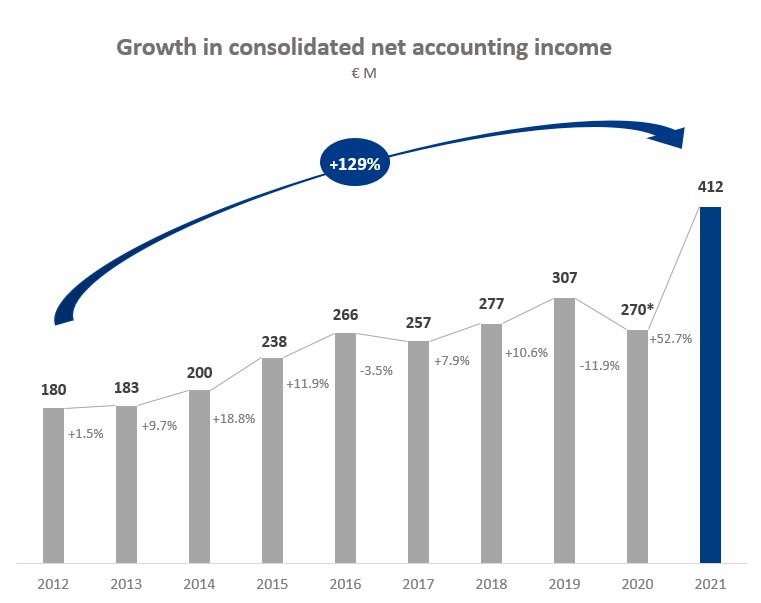
*The decline in 2020 is due to the prudent provisioning of the cost of risk potentially generated by the pandemic.

Very strong solvency and liquidity ratios

Shareholders’ equity amounted to €5.8 bn, up 14.8% over the year thanks to the excellent level of net income and a capital increase of €120 M. The CET1 capital adequacy ratio stands at a very good level of 16.55% and the overall ratio at 16.77%.

The Liquidity Coverage Ratio (LCR) stood at 138% at December 31, 2021 for a minimum regulatory requirement of 100%. BRED’s Net Stable Funding Ratio (NSFR) came in at 109% at 31 December 2021 for a minimum regulatory requirement of 100%.
About BRED

BRED is a cooperative people’s bank, supported by its 200,000 members, €5.8 bn in equity and 6,300 employees – 30% of whom work outside mainland France and the French Overseas Departments. It operates in the Greater Paris region, Normandy and in the French overseas territories, as well as through its commercial banking subsidiaries in Southeast Asia, the South Pacific, the Horn of Africa and Switzerland.

As a community bank with strong ties in local areas, it has a network of 475 locations in France and abroad. It maintains a long-term relationship with 1.3 M customers.

As part of the BPCE Group, BRED Banque Populaire operates in a variety of activity sectors – retail banking, corporate and institutional banking, wealth management, international banking, asset management, trading, insurance, and international trade financing.

In 2021, BRED generated consolidated NBI of €1.46 bn (+13.5%) and its net income amounted to €412 M, up 52.7%.

Categories
Bank

BRED Bank widely recognised and rewarded in 2021 !

Categories
Bank Global economy

Conference on « The rise of financial instability»

Categories
Bank Economical policy

Inflation could be good news for banks

As we all know, and contrary to what we sometimes read, low interest rates are not in themselves a bad thing for banks. For them, what matters is not so much interest rates as the slope of the interest rate curve. Note that in France, for example, loans, such as home loans and investment loans, are on average fairly long term and mostly fixed rate, whereas deposits are fairly short term, and are either non-interest-bearing or term deposits, which bear interest indexed to short-term rates.

If the difference between long- and short-term rates is large enough, it does not matter whether interest rates are high or low. The same slope generates the same net interest margin (NIM). On the other hand, very low long-term rates of close to zero do not enable a steep enough interest rate curve to generate an adequate NIM. This is with good reason, as deposits with negative interest rates are far from attractive and are difficult for households and small and medium-sized businesses to accept.

Rising interest rates is favorable to the NIM

In practice, banks quickly see an increase in their NIMs if the interest rate curve moves steadily upwards. The reverse also applies. This counter-intuitive effect is due to loans being rolled over faster than savings. When short- and long-term interest rates rise, the average outstanding loan rate rises faster than the average outstanding deposit rate, which is usually indexed to regulated rates.

Conversely, when the curve falls, interest rate adjustments and early home loan repayments gather pace. Households therefore benefit from the drop in interest rates, while liability-side investments by households, in housing savings plans, for example, are rolled over less quickly, as households want to keep the previous, more advantageous rates, for longer.

The European Central Bank’s crucial role in the equation

What impact might inflation therefore have on banks’ NIMs through the change in interest rates? Given what they are announcing, the most likely scenario is that central banks will reduce their quantitative easing by gradually stopping their net purchases of long-term securities on the markets, or tapering, before raising their key rate, i.e. short-term rates. This could have a positive effect on banks’ NIMs, since long-term rates could rise faster than short-term rates, thereby steepening a slope that is currently very flat.

This would also be good policy, as the central banks would gradually stop underpinning financing conditions, as growth and inflation picked up, while allowing banks to effectively finance loan applications thanks to the lessened impact of quantitative easing on profitability. This positive effect should not, however, obscure the impact of the simultaneous disappearance of the support provided to banks by central banks, particularly through tiering and Targeted Longer-Term Refinancing Operations (TLTROs) in the euro zone.

Another factor that should now be considered is volumes. Movements due to the interest rate effect, i.e. the change in NIMs, may be more or less offset by the volume effect, in other words changes in loan and deposit outstandings. In fact, by setting off the interest rate effect against the volume effect you ultimately arrive at the change, by value, in the NIM itself.

A cautious normalisation of monetary policy would theoretically have a positive impact overall. If rates were to rise gradually and fairly smoothly, the resulting volume effect should be relatively neutral. If the central banks went ahead with this normalisation only very gradually, and after announcing it, which is the most likely scenario, this might also limit the ups and downs on the financial markets.

However, if, for one reason or another, the central banks did not respond to a sustained increase in inflation, their credibility would be undermined, and long-term rates would rise more sharply, while short-term rates would be flat. Demand for both housing and investment loans could be affected, possibly generating a negative volume effect, or a less positive effect than under a gradual approach. The bond and equity markets could experience substantial capital losses.

A bleak scenario to be avoided

In such a scenario, the bubbles would deflate more quickly and the shocks to both bank balance sheets, and the balance sheets and profit and loss accounts of banks’ clients, could be more severe, and have repercussions for bank provisions and trading income. Highly indebted companies and states that failed to prepare for the likely rise in interest rates could suffer even greater consequences.

The central banks therefore play a major role. In order to prevent the forming of excessively large bubbles, even if inflation is contained, sooner or later they should normalise their monetary policies so that nominal interest rates are not left too far below the nominal growth rate for too long.

Categories
Bank

[PR] BRED GROUP: capital increase for BRED (Vanuatu) Limited and growth of BRED Bank Solomon Islands

Strong presence of BRED (Vanuatu) Limited

Founded in 2008, BRED (Vanuatu) Limited is the number 1 bank in the loan segment (market share of 36.8%[1] in Vanuatu. BRED (Vanuatu) Limited shows how much the Pacific banking market can be the growth driver for BRED Group.

The €5 million increase brings the issued and paid up share capital to €26 million as at June 21. This increase strengthens BRED (Vanuatu) Limited’s capacities and demonstrates the confidence in the future that BRED has for this region of the pacific, with the opening of a third branch planned for 2022 in the capital Port Vila, near Bauerfield International Airport.

Express growth for BRED Bank Solomon Islands

Established recently in 2018 and despite the pandemic, BRED Bank Solomon Islands has continued with its growth, market penetration and ambitions. The fourth and latest arrival on the Solomon Islands banking market, it took only three years for the bank to set its strong hold and footprint by capturing second place of the loan market with 21.2% [1] share.

This success was reflected in the opening of a second branch in January 2021 in the heart of the business district in the city centre of Point Cruz. This new point of contact close to its customers created around fifteen new jobs.

“Banking without distance” ambassadors

BRED (Vanuatu) Limited and Bred Bank Solomon Islands will use this capital increase to further disseminate the global customer approach and value-added advisory model that define “banking without distance”.

Wherever it is present, BRED’s international network is based on its success in maintaining close relationships with its customers through the work of advisors who support them in all their projects, offering them the best of both face-to-face and digital services.


[1] Figures as at 30/06/2021


About BRED Group

BRED is a cooperative Banque Populaire, supported by its 200,000 members, 5.2 billion euros in equity, and 6,000 employees – including 30% outside France and the French Overseas Departments. It operates in the Greater Paris region, Normandy and in the French Overseas Departments, as well as in Southeast Asia, the South Pacific, the Horn of Africa and Switzerland via its commercial banking subsidiaries.

As a community bank with strong ties in local areas, it has a network of 475 business sites in France. It maintains a long-term relationship with 1.3 million customers.

As part of the BPCE Group, BRED Banque Populaire operates in various activity sectors: retail banking, corporate banking for large– cap companies and institutional investors, wealth management, international banking, asset management, trading, insurance, and international trade financing.

Categories
Bank Management

BRED Group shows positive growth in all its activities

Commercial banking France and the capital markets division continue their strong momentum

In the first half of the year, commercial banking France once again confirmed its very strong momentum, with revenues up 7% compared with the first half of 2020, after a cumulative increase of 45% over the past eight years. This growth was driven by changes in savings deposits and loan outstandings, the increase in market share and better customer equipment, which strongly offset the effects of lower margins. Outstanding customer loans increased by 16.7% and deposits by 8.1% compared with the first half of 2020.These results were made possible by the intensification of the overall close relationship in each of the customer segments in France.

Branches fully dedicated to advisory

This trend in the network is the result of ongoing investments in branches and digital tools, as well as the training of its advisors, which are wholly dedicated to customer advisory services.

In 2020, BRED Group rolled out a branch model fully dedicated to advisory. This new organisation allows our advisors to spend more time on their customers’ projects. Customers choose their methods of interaction: telephone, video or face-to-face at the branch.

This new organisation has led to a sharp increase in meetings and new relationships, while the attrition rate has declined significantly. In addition, the average coverage rate has passed the threshold of 10 products per customer, with significant growth in property and casualty and personal protection insurance. The unit-linked rate in life insurance inflows increased to reach 58%.

A leading business partner

BRED is a major partner for companies of all sizes, SMEs, ISEs, large corporations and institutional investors. BRED has strongly supported its corporate clients during the pandemic, both in credit and in advisory services (€2.3 billion in government-backed loans since April 2020).

It provides tailored solutions in flow management, international development and structured financing.

It is also supported by its trading desk, which posted an excellent performance in the first half, and which is a key player in the European money market. It further strengthened its leading position with more than €100 billion in outstanding negotiable debt securities placed with international investors. BRED is also a recognised player in the private debt segment, also through financing incorporating non-financial criteria (ESG), with more than €1 billion arranged to date on behalf of SMEs and ISEs.

BRED is one of the five French banks and 39 European banks to have been selected by the European Commission as Primary Dealers for the placement of its debt issues under the NextGenerationEU plan. It also places the short-term debt (less than one year) of Austria, Ireland, Belgium, the Netherlands and Estonia.

BRED consolidates its international growth

BRED has strengthened its international presence and posted revenue growth of around 18% at constant exchange rates. It benefited from strong growth in Cambodia and the Fiji Islands, as well as an excellent performance in international trade financing in Geneva.


BRED Group carried out two capital increases to speed its development in Asia-Pacific. A first of USD 35 million for its subsidiary BRED Bank Cambodia, the leading European commercial bank in Cambodia, a second of USD 36.5 million for its subsidiary BRED Bank Fiji, which significantly increased its market share in the first half of the year.


BIC BRED Suisse, its subsidiary specialising in international trade financing, posted a very good performance, mainly due to the 19% increase in its client portfolio in one year and the rise in commodity prices.

Very good half-year results

NET BANKING INCOME INCREASES
FROM 25% TO €764.7m

COMMERCIAL BANKING FRANCE NBI
UP 7%

INTERNATIONAL BANKING NBI
UP 18%
(at constant exchange rates)

COST/INCOME RATIO
OF 53.1%

NET INCOME OF €237m

EQUITY OF €5.2bn

BRED Group posted a sharp increase in consolidated net banking income (NBI): +25% to €764.7m. Excluding exceptional items, NBI increased by 28.1% to €761.5m.

Operating expenses increased by 6.7%, reflecting ongoing investments in IT systems and the digitisation of processes, the modernisation of the branch network, as well as in international development. Restated for the increase in variable remuneration resulting from improved results, operating expenses increased by 2%.

This led to a 55.2% increase in gross operating income (65.5% excluding exceptional items).

BRED thus has a cost/income ratio of 53.1%.

The cost of risk amounted to €54m, down 27%. There was no reversal of provisions on performing loans and receivables (phases 1 and 2) in the first half of the year.

The Group share of net profit for the first half was €237.1m. Excluding exceptional items, it came in at €235.1m.

Shareholders’ equity amounted to €5.2 billion at 30 June 2021, with an excellent overall solvency ratio of 17%.

About BRED Group

BRED is a cooperative Banque Populaire, supported by its 200,000 members, 5.2 billion euros in equity, and 6,000 employees – including 30% outside France and in the French Overseas Collectivities. It operates in the Greater Paris region, Normandy and in the French Overseas Departments, as well as in Southeast Asia, the South Pacific, the Horn of Africa and Switzerland via its commercial banking subsidiaries.

As a community bank with strong ties in local areas, it has a network of 475 business sites in France. It maintains a long-term relationship with 1.3 million customers. As part of the BPCE Group, BRED Banque Populaire operates in various activity sectors: retail banking, corporate banking for large– cap companies and institutional investors, wealth management, international banking, asset management, trading, insurance, and international trade financing