Category: Bank

Are bitcoins and other cryptocurrencies real currencies? They are essentially a product of a utopian world in which money would no longer be national but universal, valid in all countries and for everyone, and able to be transferred completely securely and without cost.
This currency would require no intermediaries and its value could not be manipulated by governments or central banks. It would be subject to private, decentralised management. It would guarantee the anonymity of transactions and its guardian would not be a central bank but an algorithm, supposedly infallible. In short, a form of anarcho-capitalism.
In the 1970s Friedrich Hayek and the Austrian school advocated the denationalisation of money by doing away with “the monopoly of government supplying money and to allow private enterprise to supply the public”. In some ways, the development of cryptocurrencies could be fulfilling this wish.
Gold as a counterparty
The first banking currencies were issued in quantities that were necessarily multiples of bank assets in precious metals, gold and silver. They circulated and were regulated freely by supply and demand, without state or centralised intervention.
The currency was subsequently issued not as a proportion of assets in gold or silver but consistent with the development of the economy. Money is thus created from credit. And loans make deposits. In other words, it is still the banks that create money.
This system is supervised by an institutional authority, the central bank, as there is no longer a self-regulation mechanism based on the convertibility of each currency into gold or silver.
Central banks were created following the serious financial crises of the late 19th century and the repeated bankruptcies of banks issuing money backed by gold or precious metals. By harmonising the currency sector and playing the role of lender of last resort, central banks created the possibility of stability and demonstrated the usefulness of institutions and rules.
Hyperspeculative assets
Cryptocurrencies have no counterparty, be it gold or silver, or the needs of the economy, since they are issued by private individuals according to arbitrarily set rules. Consequently, we are seeing a huge increase in private “currencies”, today totalling over 1,600! It is fairly clear that if everyone can create “currencies” from scratch, none of these currencies can earn the universal trust necessary to acquire the true status of currency.
Furthermore, if the economic system were to rely solely on these private currencies with no constraints on issuance, then it would quite simply no longer work, as there would no longer be any monetary constraints.
Rather than currencies, then, cryptocurrencies are financial assets at best. And for all the reasons set out above, their value is extremely unstable. A dip in confidence is enough to trigger a drastic slide in their value. Conversely, when their value rises, more and more people buy them, pushing up their price with no apparent limit and “in a vacuum”. This leads to speculative bubbles that may burst at any moment.
Cryptocurrencies at heart are hyperspeculative assets, as created by the financial world from time to time when it completely loses sight of the real economy.
That said, while these pseudo-currencies do not contribute to the common good (in the words of Jean Tirole), the encryption technology on which they are based, i.e. the blockchain, undoubtedly has a bright future and initial coin offerings (ICOs), under extremely strict conditions, are a project-financing method that broadens the range of possibilities. These last should not be confused with cryptocurrencies themselves, which are merely the product of a potentially dangerous utopia.
Please find my point of view, published in Les Echos “The arnacho-capitalist utopia of cryptocurrencies”

Bitcoin and other cryptocurrencies are essentially a product of a utopian world in which money would no longer be national but universal, valid in all countries and for everyone, and able to be transferred completely securely and without cost. This currency would pass through intermediaries, and its value could not be manipulated by governments or central banks. It would be subject to private, decentralised management. It would guarantee the anonymity of transactions, and its guardian would not be a central bank but an algorithm, a supposedly infallible IT programme. And, at a push, it would be possible for everyone to launch their own project to create a private currency, outside of controls and regulation.
It is a libertarian utopia that abrogates the role of the state, institutions, banks… what a dream!
I will try to demonstrate that it is precisely a utopia and that it cannot work in this way.
This analysis is based on monetary theory.
We must first ask ourselves if these cryptocurrencies are appropriately named and if they are really currencies. Going back in history, we find the hypotheses of Friedrich Hayek and the Austrian School, who, in 1976, called for the denationalisation of money, “to take from government the monopoly of issuing money and hand it over to private industry”. In some ways, the development of cryptocurrencies could be fulfilling this wish.
However, bitcoin is not a currency in the classic sense of the term. It is not a unit of account, or a medium accepted everywhere (in fact by very few merchants) to exchange value, and is extremely volatile. But nevertheless, it is a form of private money, without a central bank, as it is exchanged between the members of the “clubs” that hold it. It is created by a private issuer who benefits from it. Because, remember, when someone creates a private currency in the form of a cryptocurrency, as the issuer, they receive a very small percentage of the amounts issued.
We must also question the nature of the counterparty of the currency created. Another look at the history books shows us why cryptocurrencies are intrinsically unstable and why they are not currencies. In the 19th and then at the end of the 20th century, two schools of thought came into conflict, that of the Currency school and that of the Banking school. The Currency school considers that quantities of currency must be based on holdings of precious metals, either gold or silver. These are private currencies, issued by banks. They circulate and are regulated freely by supply and demand, without state or centralised intervention. The convertibility of currencies into gold or silver in fact penalises the banks if they issue too much, and, reciprocally, their results are weighed down if they do not issue enough.
For its part, the Banking school considers that the best counterparty for the currency is not gold or silver, but economic development. Money is created from credit. Today, loans make deposits. In other words, it is still the banks that create money, but they do so depending on demand for credit, thus mainly the needs of the economy. And this system must be regulated by an institutional authority, since it is not self-regulated by the convertibility of each currency into gold or silver. Regulation is therefore the task of an external organisation, the central bank, which has a number of instruments to influence, as much as it can, the quantity of credit distributed by the banks.
In both cases, there is a point of reference, whether it is the needs of the economy and central bank policy, or precious metals. In addition, the Banking school implies that there is a unification of the value of each private bank currency by the necessary conversion to prices fixed in the currency issued by the central bank. The currency area is thus homogenised and the quantity of currency issued regulated by central bank policy.
The debate between these two way of thinking is in practice outdated, because central banks were not created on the bizarre whim of a bureaucrat who wanted to create administrations to control currencies and individuals, but quite simply as a response to a series of extremely serious financial crises that occurred at the end of the 19th and the beginning of the 20th centuries, owing to repeat bankruptcies of banks, while they were issuing currencies convertible against gold and silver. Without a central bank to homogenise a currency area, these currencies could carry different values depending on the degree of confidence accorded to each issuing bank. Until confidence completely disappeared, as did the bank itself, though a series of cumulative processes. . By homogenising the currency area and playing the role of lender of last resort, the central bank has thus created the possibility of stability, thereby preventing the recurrence of financial crises or considerably dampening the effects of such crises on the real economy.
Moving on to our argument, all this explains why cryptocurrencies are not really currencies. They have no basis. They do not have as a counterparty gold or silver, or the needs of the economy, since they are issued by private individuals depending on rules set arbitrarily by these individuals and without any objective reference outside the cryptocurrency system itself.
In addition, newly-created “currencies” have proliferated (more than 1,600 cryptocurrencies!), which we can clearly see is unrealistic, because it is not in any way linked to the development of the real economy. To be a currency, economic players must have confidence in the currency issued and accept it as a discharge payment method, i.e. as a means of definitively releasing the debtor from his debt to a creditor or supplier. We can see that if everyone can create a currency from scratch, without counterparty or external regulation, none of these “currencies” can win the necessary confidence from everyone to acquire the real status of currency. In addition, if everyone could issue its own currency, no monetary constraint would therefore be possible and the system could not work.
I would not therefore say that it was a currency, but at best a financial asset. And, for all the reasons set out above, a cryptocurrency’s value is extremely unstable. A fall in confidence is enough to trigger a drastic slide in the value of this type of currency, or conversely, when its value rises, more and more people buy it, pushing up its price without a visible limit and “in a vacuum”. We are then faced with wild speculation, speculative bubbles that can balloon and burst at any time.
In conclusion, it is therefore at best a financial asset, but an asset that has no basis. We therefore bet on the value of this currency, through supply and demand alone, with no other reference point than the confidence that we have in future supply and demand, and without any objective reference point relating to the value of a company or economic development. In this case, we are in a purely self-referential situation. It is therefore in essence a hyper-speculative asset, as is created from time to time in the financial world, completely detached from the real economy.
Institutions exist precisely because they respond to a need for regulation to avoid this type of chaos and crisis. It is undoubtedly not the time to try and destroy them.
In conclusion, I would like to recall the words of a columnist from the Financial Times, who said that the way economists have paid no attention to cryptocurrencies is only equalled by the way in which cryptocurrency enthusiasts do not care about the economy. Finally, as Jean Tirole highlights, while blockchain is useful, cryptocurrencies do not contribute to the common good.

High street bank’s advantages to counter the threat of uberisation
Olivier Klein
The word “uberisation”, taken in a broad sense, can be used to refer to the threat to an established model posed by a succession of innovations and the involvement of new parties. The question that arises today is whether the banking sector is experiencing uberisation and if so, what advantages do banks have to fight it? It is possible to establish arguments in response to these questions with a fair degree of certainty.
Retail banking is seemingly more affected by the phenomenon of uberisation than business banking. Digital innovations, which can find a use in banking, take various forms, including robotisation, digitisation of processes, agreements and signatures, big data, artificial intelligence, payments and many others. Such innovations are evidently highly disruptive and create many revolutionary possibilities, which should be analysed and incorporated into bank strategies.
Two types of disruption in the wake of this technological revolution are particularly worth studying, firstly the possible shift to virtually unique online banking model known as “neo-banking”, and secondly the appearance of new players, in particular start-ups such as fintech firms, competing with commercial banks in profitable segments within their value chain.
Both these issues are important and different, even if the responses that they generate might sometimes overlap.
Is it possible to imagine banking without branches ?
Some analysts describe banking as “tomorrow’s Kodak” or, less radically, as the “next steel industry”. The subject deserves responses that are built on a sound analysis. First of all, the issue of digital technology must be distinguished from that of interest rates. We are at the point where the two phenomena meet, but they have nothing to do with each other. On one side is a very flat interest rate curve which harms retail banks’ profitability. There is a reasonable expectation that rates will rise again, in particular to produce a sufficient gap between short-term and long-term rates, and the central bank will gradually emerge from quantitative easing, since it has already begun to recalibrate its actions in this area.
On the other side is digital technology and its effect on profitability. It would be a mistake to use digital technology to respond to interest rate issues in the belief that low interest rates are changing the model structurally. Interest rates at time ‘t’ do not change the model in itself, but do temporarily harm profitability, which is different.
Retail banking : day-to-day banking and banking for customers’future plans
The following arguments are a return to fundamental questions, namely what is the very essence of retail banking and what is the essence of the banking relationship? A clear distinction needs to be made here between invariants and contextual aspects that change according to the technology currently used and its adoption by customers. In retail banking, the model which may differ from one country to another depending on the custom and practice specific to each, there are two main areas, i.e. transaction banking or the “day-to-day” component, and relationship banking concerning customers’ plans for the future and financial advice. They are two separate types of banking demand, although they naturally often overlap.
Day-to-day banking is that of commonplace transactions – collecting a chequebook, making a payment, withdrawing or depositing cash, and so on. The development of the internet, smartphones and ATMs means that a transaction bank has almost no need for a branch network to perform these commonplace transactions. Branch footfall has decreased significantly, and there is therefore a constant decline in demand for counter services.
Relationship banking, meanwhile, relates to customers’ future plans and providing advice, offering support during difficult times that can happen to anyone sooner or later. It characterises the deepest relationship between consumers and their bank, well beyond just managing means of payment. Such a bank retains its customers for a long time. This lengthy period is tied to the fact the bank looks after customers’ future plans, from preparation to completion. Such plans can be highly significant, such as paying for studies, setting up a business, buying a house, pension planning, and so on, or be on a smaller scale and arise more frequently, such as planning a trip or buying a car. A lasting and strong relationship of trust is forged between the customer and the banker. The range of needs met by relationship banking can therefore be described as long-term, likewise the products offered, i.e. credit, savings and insurance, all of which are long-term products.
Opposing schools of thought are routine within a society. In the late 1990s and the 2000s, many questions were raised about whether supermarket chains were going to replace banks. At the time, numerous articles appeared opining wisely that supermarkets were going to swipe whole swathes of bank revenue. However, this did not happen, for the simple reason that supermarkets run a short-term business, where the products sold are consumed almost immediately. If a product fails to satisfy a customer, it is easy to change the brand, or indeed the supermarket chain used, which is not the case in banking as taking out a loan, savings account or insurance policy is, as a general rule, a longer term commitment. Bank advisors consequently need to stay in their jobs for a sufficient length of time, which customers very much prefer to see. In supermarkets, in the main, sales staff have vanished from the stores. At the time, it was consequently difficult to believe that supermarkets could take significant market share from the banks, precisely because a fundamental analysis of the very essence of the banking relationship showed that savings products were not bought shrink wrapped. The only overlap between supermarkets and banks occurred in the area of consumer credit, payment cards and loyalty schemes, all of which are an extension of the purchasing act. Until now, this has been the only area where there really has been genuine competition between supermarkets and banks.
Furthermore, different countries feature different mixes between relationship and day-to-day banking models. Research conducted on behalf of the French Banking Federation in 2010 attempted to find out which countries had banks with a strong relationship component. France was one such country, which did not mean French banks were not transaction banks, but simply that they had assigned relatively greater importance to the relationship aspect compared to many other countries. Countries that have models that are much more transaction-based than relationship-based therefore see a benefit in closing numerous branches, as their branches do not have enough products to offer. For relationship banking, the issues are different and the prospects more promising.
Fewer counter transactions presents an opportunity for banks
People are therefore travelling less and less often to banks for their day-to-day banking needs. But does this mean customers have less appetite for relationship banking services? Over the last ten years, relationship channels with bank networks have changed, to now include physical visits, telephone banking, email, video, online chat and others. However, they have not eliminated the need for bank advisors. But while there is still the same, if not more, need for advice, customers need to know where their advisors are.
ustomers want to physically see their advisors at regular intervals, either to deal with specific important matters or just for reassurance. Having local branches is therefore not entirely inappropriate, especially as they are also, as a location physically representing the bank, a means of reassuring a large number of both retail and business customers. So as these local branches already exist, why not take full advantage them? Furthermore, they have an advertising presence on the high street that is the envy of online banks.
In this way, relationship channels are changing and dovetailing but not being lost. Ultimately, they are really essentially based on the relationship with the customer advisor. The core element does not change, because there is no drop in demand for banking in relation to customers’ future plans, quite the opposite. With the internet, customers are increasingly demanding as regards the quality of advice received, as they know exactly how to use it to find information, compare and switch if need be. They require advisors to be even better, more responsive and more proactive than in the past.
In reality, the decline in counter transactions is actually an opportunity for banks, which is not the paradox it might seem. Firstly, digital technology has eliminated the repetitive counter tasks that earn banks nothing and costs are saved as a result. Much more sales time can also be allocated to customers who are asking for more, while converting people who were previously counter staff to banking advisors. Most of the time, such people are easy to train up, being younger staff and keen to advance. Thanks to digital technology, there is more time to sell banking products, and commercial staff can be spared repetitive tasks.
Secondly, as a consequence of the first point, advisors’ productive commercial time can be expanded, leading to increased productivity. Banks’ gross income is consequently increased through their greater capacity to advise and serve customers and thus meet their requirements.
Thirdly, digital greatly enhances the customer experience because some transactions are easier to conduct remotely or using ATMs. Customer satisfaction is therefore improved by greater bank usability.
Lastly, digital technology is also an opportunity as it enables the relationship model itself to be improved. Big data and artificial intelligence, as they are gradually incorporated, deliver better understanding of customers and their needs. This is a matter of intelligent sales productivity, and customers are much more satisfied as they are only contacted about subjects that relate to their actual requirements.
Take the high road : invest massively in improving skills and in digitalisation
Improving banks usability and the quality of advice are therefore both key to success. Two routes enable high street (i.e. branch-based) banks to achieve this, namely training and digital technology itself.
If high street banks deliver the same usability as online banks but without such low bank charges, then they need to differentiate themselves in some other way, i.e. high-quality advice. Although they are entirely legitimate operations, purely digital banks do not have any advisors.
In actual fact, customers in France are demanding both, i.e. a highly practical day-to-day bank, and a regular advisor who can offer them some added value. They therefore only try to split transaction banking from relationship banking, or even make do with a single, day-to-day, low-cost bank, when their usual bank does not excel in both areas.
High street banks therefore hold a definite comparative advantage, albeit subject to two conditions. Firstly, they must continue to invest to be as effective as online banks in terms of usability in day-to-day banking, which is totally feasible. Secondly, they must ensure they have the capability to deliver high-quality advice, worth paying for because of its added value. Significant investment in digital technology and training therefore constitute two key success factors to counter the threat of uberisation.
However, flexible organisation of both the network as a whole and each branch, together with optimum use of resources to allocate them to the greatest revenue generators, is also crucial. In some cases, banks may close branches because the need for day-to-day transaction counters is disappearing. It is consequently no longer vital to have a branch every 200 metres in city centres, although they are still essential for providing advice. Depending on current bank locations, the number of branches to be cut might vary considerably.
In addition, online banking is not profitable at this point, or only very slightly, precisely because it experiences great difficulties in supplying customers Furthermore, it has to incur considerable costs to acquire new customers, as it needs to advertise much more heavily than other banks to do so. Having no high street presence, online banks must attract customers before they simply wander into a high street branch. In a similar vein, online banks need to offer plenty of gifts and free offers. For example, €80 is the typical bonus paid on opening an account. Many students open accounts with more than one bank in turn in order to obtain these payments. Customer loyalty is therefore not straightforward. As a result, low-cost online banks must essentially focus on transaction banking. Generating profit from such business models and leveraging customers accordingly becomes fairly difficult, unless the range is expanded and advisors recruited, which is in fact starting to happen. Low-cost services, almost by definition, cannot ensure contact is always with a regular advisor. They therefore must make customers pay each time they use an advisor. In addition, when the low-cost banking service is provided by an existing high street bank, when customers need to deal with a personal issue or obtain advice in preparing or completing some long-term plan, they are forced to switch product category and stop using the low-cost service. Such a development, still rare, is very inspiring, as it could herald a situation where some traditional banks go partly digital while online banks up their game by hiring banking advisors. These two levels of banking would then move closer together in an interesting way.
Dispensing with people in delivering advice
The question then arises: can banking advice itself go digital? The following thought process seems simple enough: with properly organised big data and well-designed artificial intelligence, automated “pushes” (by text message or email) to customers would make human advisors pointless. Customers could receive intelligent suggestions, sometimes perhaps even more intelligent than those made by an inadequately trained or poorly supported advisor. Why therefore would we need banking advisors in future, when everything has been made digital? Although it is impossible to see 10 or 20 years ahead with any certainty, it is difficult to envisage eliminating people from the provision of banking advice.
Machines are admittedly able to beat human endeavour in many fields, but man and machine combined will beat a machine alone. Some humility is nonetheless called for, as who knows at this point what artificial intelligence will be able to achieve in future?
rtificial intelligence experts themselves adopt a cautious stance. There are however a number of factors to take into account.
The first is that trust is a key component of the banking relationship, for one simple reason, namely that customers entrust their money to banks and need their support in achieving their future plans, which makes banks very close to customers and vital to their security. Personal interaction currently generates infinitely more trust than dealing with a robot, no matter how “intelligent”. Younger people, completely at ease with digital technology, are for example asking banks to provide a regular advisor, even if they do travel to branches much less. BRED conducted an experiment whereby banking suggestions were sent by text message or email to groups of customers in identical situations. As ever when email shots are dispatched, a positive response rate of 2-3% was received. Secondly, the shot was sent to other people, in the same situations, but this time with a follow-up phone call from a banking advisor on the same subject. Response and conversion rates were ten times higher. This small, but genuine, experiment, gives grounds for real hope that people will remain a core component of the banking relationship.
The second issue relates to the fact that a bank’s reputation is also part of the basis for trust, which is an added value and an asset for banks.
In addition, cognitive science is now showing that decision-making involves not only rational intelligence, but also emotional intelligence. Research presents cases of individuals who have sustained injuries and lost the use of that part of the brain used for emotional intelligence. Such individuals then become totally incapable of making decisions, while their reasoning and analysis capabilities remain fully intact. Advances in cognitive science accordingly show that taking the right decision entails intuition about the solution combined with a proper analysis. Interpersonal relationships can therefore be a potent factor in decision making. In a similar vein, econometric research has found that learning is more effective when carried out face-to-face with a teacher than it is with a MOOC (Massive Open Online Course). Although the extraordinary benefit of MOOC in the dissemination of knowledge and its ability to reach many more learners is unquestioned, teachers (or trainers) present in a classroom still have a future.
Lastly, the population is receiving more emails and text messages each and every day, “pushed” out by unknown persons and organisations. If it has not already been reached, saturation point will soon occur. The difference will then take the form of human beings who can bring some added value to these “pushes”.
For all these reasons, high street banks are probably not threatened by extinction from anything approaching possible uberisation.
Can the technological revolution enable some players to compete with commercial banks ?
The second approach concerning uberisation consists of asking whether banks might suffer a loss of profitable market segments as a result of the arrival of outsiders, such as fintech outfits currently enjoying a boom.
In fact, fintech firms are increasingly developing services relating to certification and authentication, biometrics, budget management, secure digital archives, aggregators, payments, blockchain, etc. The question is therefore whether banks are running the risk of disintermediation affecting the profitable areas of their value chain.
The model that could legitimately cause concern is that of external aggregators, which can now potentially access data, offer fund transfer services, and therefore initiate payments. These aggregators have the capability to offer budget management services, for example. It then naturally follows to wonder what would prevent them in future from analysing customer data so as to able to offer improved banking products and services. Such players could in particular offer consumer credit using brokers and by offering the lowest bidder – but not necessarily the most appropriate – which might not be the customer’s usual bank. This hypothesis of part-disintermediation of banking is entirely conceivable, but the related hazards may be mitigated by a number of other factors.
In the first instance, many fintech outfits will not have access to customer data, those offering budget management software, for example. It is only with some difficulty that they will manage to take market share from certain segments currently dominated by banks. Two solutions are available to such fintech firms, either cooperation with specific banks through the latter buying the former or through partnerships, or the building of collaborative platforms with a number of other banks so as to offer services that can be shared. By taking action of this kind, fintechs are moving into and joining the banks’ value chain, but without however disrupting their model. They are even contributing to enhancing that model by forcing banks to broaden their services to become even more effective in their overall model with their customers. By way of example, BPCE Group actively sought out fintech firms to offer business customers CRM solutions linked to payments. Consequently, banks either have the necessary IT investment capacity and can enhance their services themselves, or they look to subcontract this work. In reality, the solution is often based on a mixture of these alternative approaches. The change will be that hitherto the bank was used to doing everything itself, whereas in future it will probably also be an assembler of components, and no longer entirely self-contained. There is nothing wrong with assembling components if it enables banks to broaden their overall relationship base, and their revenue.
The second case, which might obviously cause problems, is where the fintech firms do have access to some customer data. Web scratching – which could well soon be made illegal or at least strictly regulated – and PSD2 and API more generally give rise to the question of opening up access to bank and customer account data. All banks have now built their own aggregators so that their customers do not have to leave the bank’s environment to get access to their accounts held with their other banks. In the near future, regulations will require access to data to be governed by strict consent rules, making it much more difficult for parties external to the customer’s bank to process data, whether or not those parties are themselves banks.
Discussion is focused on establishing which data it will be possible to access. Customers and the general public are nowadays increasingly aware of the dangers of permitting uncontrolled use of their data. This trend is likely to accelerate, and can be seen particularly in young people. This greater awareness is an obstacle to such intrusions.
Furthermore, the General Data Protection Regulation (GDPR), in force since May 2018, reiterates that data belongs to customers, and customers must approve any use made of it. This regulation applies not only to banks, but to any and all users of data, so it also restricts third-party newcomers from using data in a cavalier fashion. The bank must remain the trusted third party that processes people’s private data, and obviously must not allow that data to be disclosed without customers’ express consent.
High street bank survival relies on their taking the high road based on an agressive strategy
Banks’ ability to survive and in fact improve their overall relationship model with consumer customers by offering and new, built-in services, will therefore be crucial in withstanding uberisation.
While banks are investing heavily in training and digital technology, and at the same time are bringing about essential changes to their organisations, there is no reason to think that the branch-based retail banking model will vanish. On the other hand, as in any model that endures, it can no longer remain undiluted but instead it must blend very closely with the digital model. These days, in all fields of distribution, pure digital models are struggling to survive and purely physical distribution models are dying. The future will therefore consist of the right mix between traditional and digital models, and the route to the right response will be found by understanding what forms the very essence of the banking relationship.
In banking as elsewhere, the risk of uberisation will have stimulated competition a great deal, which is vital in a highly-regulated sector not usually conducive to rapid change. Besides this stimulating effect which will have resulted in improvements to the banking model to customers’ benefit, uberisation also threatens to drive down profitability owing to newcomers exerting pressure. To respond to this threat and increase revenue, other areas could be developed in parallel to the recurring business of commercial banking.
The risk of uberisation needs to be assessed in depth against the yardstick of the advantages of commercial banks. Taking the high road in this way does appear possible, then, provided the necessary changes to be applied are properly assessed, and an intentionally aggressive strategy is adopted.
You can find the original Conclusion here.
Categories
The future of retail banking.

My first thought is that it is a rare day when, on opening the newspapers, we do not see articles about banks, predicting that we are the new steel industry. I even recently read we are destined to turn into Kodak, which as everyone knows failed to see the technological revolution, fatally as it turned out. So working in banking is very encouraging at the moment. Many employees in our banks are accordingly in a state of uncertainty, and some are just plain seriously worried about the future of jobs in banking.
I am going to try to deal with the topic by revisiting what the President said to introduce the subject. Bill Gates in fact said that “banking is necessary but banks are not”, which is entirely in keeping with the Kodak episode.
I would nonetheless like to remind everyone that he said it in 1994. I feel bound to point out that banks are still here. We will try to demonstrate, rather than just believe, that retail banks will still be here for many years.
Obviously, though, the question arises, and rightly so, because digitisation and globalisation are, in my view, two fundamental revolutions we are experiencing. These are really the two major factors changing the lives of companies and banks in particular. Digital is a technological revolution, but also as a consequence, a revolution in customer behaviour, including in their dealings with banks. Accordingly, the number of customers in our branches is seen to be decreasing considerably and continuously, which leads some to think that as people no longer come to branches, we no longer need branches and no longer need customer advisors. Therefore, the only option, the best option, is said to be a defensive stance. Cut our cloth as much as possible.
I think there are fundamental questions that need to be addressed, which cannot be swept under the carpet, but at the same time, I think that banks, and here we are talking more about retail banks, have some valuable trump cards they can play. The point is, however, not to stick with the usual way of doing things, changing nothing. That would be fatal. On the other hand, however, I think retail banks have the potential to “take the high road” out of the situation, a road I am going to try to highlight.
To do this, we need to think a little more deeply and return to the very essence of the banking relationship and of the banking profession, in retail banking.
In actual fact, there are two areas where the bank operates, not juxtaposed but coordinated with each other, while also being different from each other. Historically in banking, there are banks I would call transaction banks, i.e. a bank for everyday banking, making payments, withdrawals and deposits. The structure of this bank means it can very comfortably digitise completely. With ATMs and smartphones, which can increasingly be used for such transactions, humans can quite simply be dispensed with.
As a result, a number of banks may appear, neo-banks, online banks, almost all of them low-cost banks, dedicated to this transaction handling role, in a cheaper and sometimes more convenient way than traditional banks. Although traditional banks have invested sufficiently lately to catch up. The reason is these new banks are starting from scratch and setting up as online, low-cost banks with very few employees. They often build a new computer system and this is infinitely easier than overhauling all your IT when it has been built layer on layer for years, as it has in all companies and especially in all banks. Consequently, customers find services more practical to use, and the cost this kind of bank can charge is inherently lower. You have to look closely though, because most of the time, when low-cost banks advertise that they are free of charge, it’s just advertising flannel.
But can these newcomers, based on new technology, cause us to disappear?
The first response from our banks is that we have considerable investment capacity and we have very valuable staff and so on. We obviously have to fight against the effects of unwieldy information systems, but nevertheless we can, by investing heavily in digital, definitely manage to digitise processes, to make customers’ relationships with their bank infinitely more practical, to ensure that we are among the best. We can at least be just as practical as the newcomers.
Is that enough? I believe that some major banks consider this to be their main line of defence, reducing costs by cutting the number of branches and customer advisers. So, heavy investment in IT is needed, absolutely necessary to develop digital, to develop “self-care”, and ultimately reduce costs as much as possible to try to move towards an intermediate model between traditional high street banking and online banking.
It is my modest belief that this strategy must obviously be considered, but it includes a high proportion of risk. It is a strategy that could lead to regular attrition of the entire system, because often when branches are closed and advisors sacked, customers are lost. And if every time we lose customers, we lose revenue, we are going to be forced to make further cuts and therefore fresh attrition results. The process is endless.
Of course, we must have optimum cost management but, ultimately, all businesses always need that. We must, on the other hand, guard against falling into the circle of attrition.
So what then is the answer? I said firstly invest heavily in digital and make ourselves at least as practical as online banks. I can tell you that most banks in France today have become or are becoming as practical as online banks. But the answer is also to take due account of the fact that online banks themselves only meet some of their customers’ range of needs.
Online banks focus on transactions. They cannot offer advice since they are not advisors. While they are gradually gaining customer advisors, they then need to be accommodated somewhere, be paid, and they need to be trained. This means their costs would rise significantly, and they would therefore no longer be low cost. Eventually, we could then see business models converge. But meanwhile, they do not have customer advisors.
What is the other part of the banking model covered by conventional banking in France? What I call relational banking. Relational banking means banking advice, banking for all of life’s plans. The bank incorporates both models and coordinates one with the other, as I was saying. In relational banking, advisors support their customers’ plans for the future and businesses’ plans. These might be major personal plans, buying or extending a home, starting work, preparing for retirement, preparing a will, preparing for children’s education. They might be minor plans, a luxury trip, the purchase of a car, etc. All this is in actual fact dealt with over a long timeframe. In the way that the transactional bank operates in a short timeframe, so the relational bank operates in long timeframes, because future plans require preparation before they are then acted upon, and they tend to happen gradually. And which are the bank products that match that description precisely? Loans, savings and insurance. These are all products that operate gradually, over a period time. So one has to save up in advance before preparing for some future plan, or save after obtaining the loan that was spent on one’s plans. French customers generally do both at once. Insurance naturally protects their property and their family. All these products constitute a comprehensive range of banking services, suited to all plans customers might have, supporting those customers and finding solutions for them and their families.
So, with supermarkets, the timeframe is immediate, not a long period. When you go to a supermarket, or any type of shop, the act of purchase is in the here and now. If you are not happy with a product, you can change brands the next day. If you are not happy with a shop because it doesn’t stock the brands you like, you can change shops the next day. There is no long-term relationship. This is also why there are fewer and fewer sales assistants in shops. They have been replaced by rows of shelves and self service. In contrast, in banking for customers’ plans, we are looking at the long run. As a result, when major retailers thought about including banking services, they stopped at consumer credit, which is the exact link between short and long term. They have stopped at payment methods, where appropriate, to expand their loyalty cards, but have not moved on to the rest. Some supermarkets have tried, but they never quite managed to sell shrink-wrapped savings accounts. For the same reasons, I think relational banking does have a future, because it meets an interpersonal need for support and guidance over the long term.
Let us delve a little deeper. Is this true is all countries? Not really. In some European countries, and more so in the English-speaking world, banking has been fragmented for a long time. Perhaps indeed banking has never been unified. In the United States, it is not uncommon for someone to have one bank for payments, consumer loans with specialist lenders, a property loan from another specialist provider, and investments placed with brokers. It is actually the usual state of affairs. In countries where banks are predominantly for transactional purposes, the strategy of severe cost cutting is inevitably followed. But France is a country where relational banking is a strong factor.
Second point. Online banks which have existed for a few years, although they are still young, are not profitable. Not one in France makes any money. Why is that? Because it is very difficult, even when costs are pared to the bone, to give customers more and more, and retain them. And that is because there are no customer advisors. Furthermore, they do not have the presence on the high street to attract new customers that we have. Obviously not, a low-cost, online bank by definition does not have a high street presence. Therefore to attract customers, they are forced to hand out the freebies you all know; €80 for a new customer and a bank card, typically for life, albeit under certain conditions. This costs online banks a great deal. Moreover, at least €50m of advertising per year is needed to sustain the brand and be in a position to acquire new customers. All in all, customer acquisition is extremely costly.
However, once the necessary investment has been made to increase the practical usefulness of banks and make them comparable with online banks in this respect, is the lion’s share of the work complete? Is differentiation by having customer advisors enough? Is the relational aspect well perceived by customers and do banks keep their word in this area? Because if the relational aspect is pointless, why then do customers not go to the cheaper online banks? Can we assume that, in the field of relational banking, traditional banks are fully up to speed? Of course not. We still need to move forward and improve upon our own business model, i.e. leveraging our differentiation. And it is by improving our differentiation, promoting it more, making it even better, more visible, more tangible, that this differentiation will probably enable us to survive and even continue to grow. In fact, by making our relational service promise both credible and demonstrable.
For example, regardless of the bank, it is possible from time to time to have advisors who know less than their customers. It is also possible to have advisors who change a great deal, every year or year and a half. As a result, long-term relationships are not established, and good customer knowledge fails to take root. I could obviously add many more items. For example, perhaps from time to time there is a lack of responsiveness in banks, service levels that are not always pushed to their maximum, and so on.
It is therefore essential for our banks, and this is what we have been doing unassumingly at BRED for the last five years, to improve this model, to drive it to its best level. One example is that our customer advisors stay in the job for three to five years with the same customers. Another example is ensuring that customers are segmented properly, on the basis of the greater or lesser complexity of their requirements, in order to place them with advisors with the skills to match. Or for example by substantially increasing the amount of training taken each year.
Incidentally, as the world goes digital and turns to robots, I am convinced that the only way to defend work in developed societies like ours is to increase the added value delivered. This is the knowledge society. It is the innovation society. If we seek to lower costs in the fight against cheaper labour in emerging countries or against imminent robots, we have already lost. It is, of course, possible to have maximum efficiency and optimum costs. These are the basic rules of business, as we have reiterated. But we must also bank on the knowledge society (pun intended). To use BRED as an example, in the last five years we have increased the training budget by 40% and now have a training budget equal to approximately 6% of the wage bill, while in France, as you know, the legal minimum is 1%. We are therefore trying to “take the high road”.
It also means changing sales methods. Meaning we don’t sell the product as the product, we analyse a customer’s requirements, which changes everything. We then look at how to offer solutions appropriate to individual circumstances, using the range of products and services we have. Our role is not to promote a product and push it onto all customers.
We obviously make use of digital there too. Consequently, we don’t only use digital for processes and we don’t only use digital to make life easier for our customers through the quality and utility of our smartphone apps, etc. We also use digital for what is known as “big data” and for processing customer data, and thus give as much information as we can to our advisors as input to best prepare for customer appointments, to deliver the best advice and the highest possible added value.
So to “take the high road” and avoid “Uberisation”, a great deal of investment is needed, consistently and following an appropriate strategy, in both digital and human capital.
Further, the number of customer appointments is in actual fact not falling, although customers no longer visit branches as much. The number is increasing, but these appointments can easily take place over the phone, or using online chat, email, etc. They are real appointments that take some time, appointments to analyse requirements and put solutions in place. Digital tech makes for better preparation for appointments, and enables us to sell products remotely when customers do not wish to travel. But always with an appropriate advisor.
It is therefore vital to put our promise of relational banking into practice and to make sure this is seen by customers to be the case, so they have no desire to leave us.
This seems to me to be the key to success. Being at least as good as online banks at the transaction side of our work. And affirming and enhancing our winning differentiation through the excellence of our relational banking model, as an advisor bank offering customers added value, which online banks, by virtue of their structure, are unable to do.
Ensure that the human factor is ever-present, essentially, because human decisions are decisions taken by both the head and the heart. That is how the decision-making process works. Rationality alone is not enough. The right decision is still something “felt”, so cognitive science teaches us. That must entail human contact, which is therefore crucial. This is and will be our winning differentiating factor: an overall model built on close relationships, augmented by technology.
THE CHAIR:
Thank you Monsieur Klein. Now it is time for questions. I will ask the first one.
What is the banks’ attitude towards crowdfunding? Crowdfunding platforms are currently springing up. What do you think of them, what is your response?
Olivier Klein
I have a slightly iconoclastic point of view on this subject.
Crowdfunding for borrowing must be distinguished from crowdfunding for private equity. For private equity, I’m in favour, because people will place a small amount of money with platforms that will invest in small business with significant growth potential. If that money is lost, too bad. If the capital grows, then great. It is just private equity through the intermediary of a platform.
For borrowing, I’m much less in favour. That does not mean it will not develop to an extent, but it will probably stay fairly minor. I absolutely do not believe it is a route to serious disintermediation of banks. The economic and social utility of a bank lies in the fact it takes the risk in place of its borrower and lender customers. What are these risks? First of all, credit risk, naturally. If you deposit money with the bank, you do not take the credit risk that the bank takes. Unless the bank goes under. In France, that is not something we often see. The cost of credit risk has no kind of consequence on the savings you have deposited. When you lend money on a crowdfunding platform, naturally you are subject to all the credit risks taken by the platform, and you shoulder that risk euro for euro. Meanwhile, the bank alone bears this risk in its own profit and loss account. A crowdfunding platform has just gone bust in the United States. The second and third kind of risk taken by the bank are connected to the fact that the bank, by creating credit and borrowing, generally borrows short term from customers (deposits) and lends long term (credit facilities). There are therefore two risks the bank takes on behalf of either borrowers or savers, and these are interest rate risk and liquidity risk. Banks regularly absorb these risks in their profit and loss accounts, and do not pass them on to customers. Moreover, banks are trained in managing these risks and are also regulated to manage them prudently. On crowdfunding platforms, this is absolutely not the case. Neither does it apply to investment funds, which increasingly undertake non-regulated banking, shadow banking.
Such risk is completely absorbed by investors, or even borrowers.
Question
Who issues bitcoin, who manages bitcoin and blockchain? How do we get access to information?
Olivier Klein
In my bank, we get questions from customers asking what we think of bitcoin and other crypto-currencies. Crypto-currencies are not true currencies in the sense they keep none of the liquidity value invested in these “currencies”, as their price can rise or fall very sharply. These “currencies” have no stability, and are not even nominally anchored. There is no lender of last resort, there is no central bank and, structurally, given what I have just said, there is no stable relationship between currencies. They are private currencies being issued, and that is how I answer your question. They are issued by private concerns who decide to launch a crypto-currency. Private concerns who launch these create a new “currency” and are entitled to take a small percentage of the amount they create themselves. I find that extraordinary.
It should be recalled that in the 19th century, central banks started to be established because private currencies were leading to major financial crises, with unpredictable swings in value; the whole thing collapsed regularly with major economic crises the result. Are current crypto-currencies founded on credit? No, there is no lending. Are they founded on the value of a precious metal? No. They are purely speculative and the whole scheme is hugely similar to tulip bulbs in Holland in the 17th century which caused a major speculative crisis.
Question
Don’t you think that in the banking industry, you tend to compare traditional banking with online banking, but rather than considering online banking as a competitor would it not be worth considering it as an additional product that you could offer those of your customers looking for another kind of customer experience and another form of relationship with their bank?
Olivier Klein
A very good question, and there are banks that have built online banks internally, and at BRED we have one called “BRED Espace”. So I really am not against online banks.
BRED’s online bank is not a low-cost online bank, and nor are those of other banks in BPCE Group. It is a bank that does everything online for people who do not want or really cannot have any kind of relationship with a branch, because they don’t have the time or because they are abroad or for a thousand other good reasons. It is also intended for students who so wish. But all these customers have a qualified advisor. We also encourage a close relationship, even if no branch is involved.
It is indeed a smart move to include online banks for some market segments. If it results in sustained losses, it is of no interest. But if models are found that can generate profits over marginal cost, naturally it could be of interest.
Let us return to the topic of blockchain. Crypto-currencies work using blockchain, but blockchain is a technology used for many other things. It is a technology that is, as you know, highly decentralised. Digital tech goes very well with decentralisation. It even facilitates it. These are therefore what are called miners, companies that develop computer data processing capabilities, storing data by multiplying checks against each other and ultimately certifying the genuineness of something. It could be a certificate, title deed, etc. So, it could be used in some African country to replace a non-existent land registry; or between banks to replace the securities custodian system on behalf of customers, etc. At BRED, we have even developed the ability to use blockchain to check customer identities, especially at the start of the relationship, because banks are now under a regulatory obligation to “know their customers” and confirm their identities. We have therefore developed a service that makes it possible to check numerous points within a few seconds, often using blockchain, to certify the identity of future customers.
So blockchain really cannot be reduced to crypto-currencies alone. The only problem with blockchain is that this way of doing things uses vast amounts of energy and ecologically speaking is probably a disaster. But technologically speaking, it is of great interest.
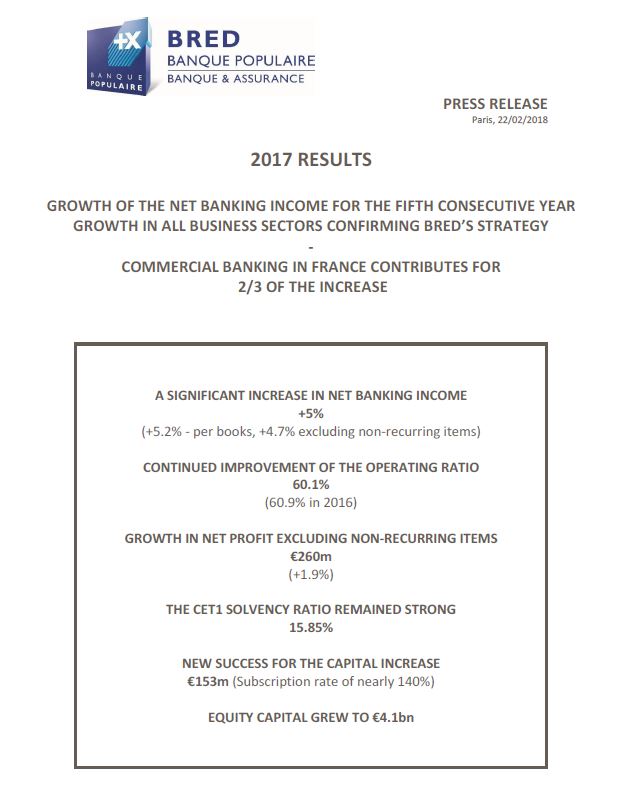
Please find here the press release announcing the BRED Banque Populaire’s results in 2017.